
Craig Biggio
Craig Biggio is a Hall of Fame second baseman, Houston Astros legend, and inspiring speaker on leadership, perseverance, and teamwork.
Craig Biggio Booking & Availability
Fees, availability and booking details for corporate events, appearances and live programs.
How do I book Craig Biggio for a corporate event?
Use the Check Availability form above to send your proposed event date, location, audience size, event format and program goals. The Mollie Plotkin Group will follow up with availability and next steps.
What is Craig Biggio’s booking fee?
Craig Biggio’s current booking fee is $30,000–$35,000. Final pricing can vary by date, location, event format and scope of the appearance.
Is Craig Biggio available for my event date?
Submit your proposed date and event details and the Mollie Plotkin Group will confirm current availability.
Who is Craig Biggio’s booking agent?
Contact the Mollie Plotkin Group to inquire about booking Craig Biggio.
What types of events can Craig Biggio be booked for?
Corporate events, conferences, leadership meetings, keynote speeches, workshops, fireside chats, private events and virtual programs may be available depending on the engagement.
Craig Biggio Appearances & Event Programs
Craig Biggio is available for athlete appearances and fireside chats for corporate events.
Discussion themes may include the MLB.
From boardrooms to locker rooms, Craig Biggio’s insights resonate with audiences looking to gain an edge in leadership, teamwork, and personal development. In his fireside chats, he delivers compelling messages on:
- Adapting to Change – Lessons from transitioning between three demanding positions in MLB.
- The Power of Commitment – Playing 20 seasons with one franchise in an era of free agency.
- Teamwork & Leadership – Lessons from the dugout that apply to business and life.
- Resilience & Overcoming Adversity – How grit and determination built a Hall of Fame career.
- Giving Back – Why community engagement and philanthropy matter.
Craig Biggio Biography & Credentials
Craig Biggio’s career is a testament to resilience, adaptability, and a relentless pursuit of excellence. A Houston Astros icon and National Baseball Hall of Famer, Biggio is the only player in MLB history with at least 3,000 hits, 600 doubles, 400 stolen bases, and 250 home runs. Over 20 seasons, he exemplified what it means to be a leader—on and off the field. His journey is filled with powerful lessons on perseverance, commitment, and embracing change. He is also well-known for his fireside chats and motivational speaking. Craig Biggio is available to be booked for corporate and private events. Contact the Mollie Plotkin Group today to inquire about Craig Biggio’s fees.
Want to book Craig Biggio for an event?
Contact the Mollie Plotkin Group at 215-995-0905 to book Craig Biggio for a keynote speech, corporate event, leadership program, workshop, fireside chat, virtual appearance, or other private or professional event.
Our team will help confirm Craig Biggio’s availability, speaking fee, travel requirements, and fit for your audience. To start the booking process, please share your event date, location, audience size, event format, and the type of presentation you are looking for.
The Mollie Plotkin Group is a full-service keynote speaker agency and entertainment bureau that helps organizations secure keynote speakers, entertainers, athletes, celebrities, and thought leaders for corporate meetings, conferences, fundraisers, and special events.
A Relentless Competitor from the Start
Born and raised in Kings Park, Long Island, Craig Biggio was a multi-sport standout. While he was a dominant football player, earning the prestigious Hansen Award as Suffolk County’s best football player, his path ultimately led him to baseball. Biggio’s determination to excel academically and athletically propelled him to Seton Hall University, where he became an elite prospect as a catcher. He was drafted 22nd overall by the Houston Astros in 1987, setting the stage for a historic career.
From Catcher to Second Base to Center Field
Biggio’s early career as a catcher was marked by immediate success, including a Silver Slugger Award in 1989. However, in a move that would define his career, he transitioned to second base in 1992. The decision was highly controversial, as no player had successfully made such a drastic defensive switch at the major league level. Catchers are trained for an entirely different skill set—framing pitches, calling games, and handling pitchers—while second basemen must have quick footwork, soft hands, and the ability to turn double plays under pressure.
Many believed the transition would be impossible, and early struggles seemingly confirmed those doubts. Learning a new position at the highest level of competition was daunting, and adjusting to the split-second decisions required at second base took time. Yet, through relentless practice and the guidance of experienced coaches, Biggio overcame the odds. He went on to win four Gold Glove Awards at second base, proving doubters wrong and setting a new standard for defensive versatility.
Biggio’s adaptability didn’t stop there. In 2003, when the Astros needed defensive flexibility, he made yet another transition—this time to center field—to accommodate the addition of Jeff Kent. For two seasons, he patrolled the outfield before returning to second base for the final three years of his career. Few players in baseball history have successfully transitioned across multiple defensive positions while maintaining All-Star-caliber performance at the plate, making Biggio’s career even more remarkable.
The Numbers Tell the Story
Biggio’s career statistics place him among the all-time greats: 3,060 hits, 1,844 runs scored (15th all-time), 668 doubles (most ever by a right-handed hitter), and 414 stolen bases. In fact, Biggio is the only player in MLB history with at least 3,000 hits, 600 doubles, 400 stolen bases, and 250 home runs. He was also a seven-time All-Star, five-time Silver Slugger Award winner, and played more games in an Astros uniform than any player in franchise history. His relentless playing style made him the modern era’s all-time leader in hit-by-pitches (285), showcasing his unwavering commitment to winning.
A Hall of Fame Honor
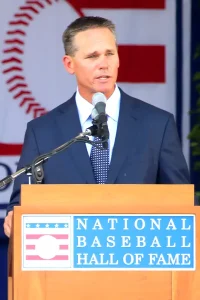
In 2015, Biggio became the first Houston Astros player inducted into the National Baseball Hall of Fame, cementing his legacy as one of the game’s greatest competitors. Throughout his career, he exemplified loyalty and leadership, spending all 20 seasons with the Astros.
Life After Baseball
Following his playing days, Biggio has remained active in the baseball community, serving as a special assistant to the Astros’ front office. Off the field, he is deeply involved in philanthropy, particularly with The Sunshine Kids, a foundation dedicated to children battling cancer. His passion for giving back and mentoring the next generation reflects his leadership beyond the diamond.