
Human Connection Beats “Wellbeing Perks” Every Time
On this page
Written by Adam Pacifico — qualified barrister, former police officer, and award-winning podcast host (The Leadership Enigma)
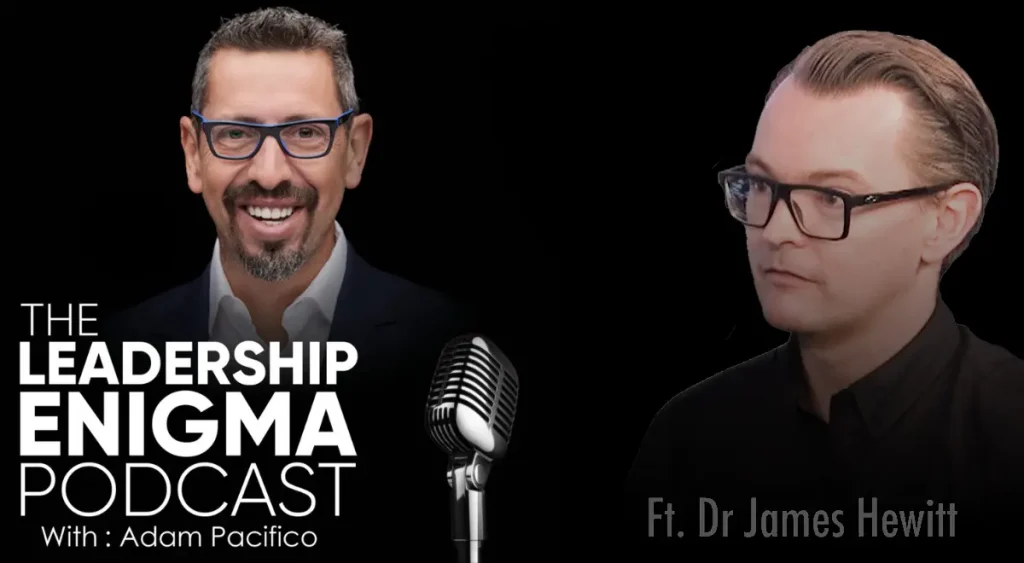
In a recent episode of The Leadership Enigma Podcast, I spoke with Dr James Hewitt about a topic many organisations say they value, but few operationalise well: human connection.
For Chief People Officers, Chief Learning Officers and the broader C-suite, this isn’t a cultural nice-to-have. Connection is a performance lever, a retention strategy, and a risk-control mechanism rolled into one. When it’s missing, you don’t just get lower morale — you get lower discretionary effort, higher friction, slower learning, poorer decisions, and a workforce that quietly checks out.
The $70bn paradox: why “wellbeing spend” isn’t moving the needle

Organisations are investing heavily in wellbeing initiatives — apps, programmes, perks, platforms — yet many employees still report that work feels worse, not better. In our conversation, James framed this as a paradox: money goes in, outcomes don’t improve.
One reason is that wellbeing is often treated as an individual responsibility (“yoga your way out of impossible workloads”) rather than a system outcome produced by how work is designed, led, and rewarded.
A practical indicator James highlighted is discretionary effort: how much energy people willingly contribute beyond the job description. When people feel well, connected, and valued, they tend to go the extra mile in ways that are sustainable. When they don’t, you see the opposite: absenteeism, low initiative, minimal collaboration, and risk aversion.
C-suite takeaway: if you want wellbeing outcomes, stop starting with wellbeing programmes. Start with the conditions of work that either enable or block human connection.
Three leadership traps that quietly destroy connection
1) Hustle culture: humans treated like machines
Hustle culture assumes pressure can be ignored and endurance is purely a matter of will. The problem is not that effort is bad — there are seasons that require intensity — it’s when intensity becomes the default. If you burn people like fuel, they will run out!
James cited research showing a powerful “cascade” effect: when leaders work after hours, it drives more after-hours work for their teams. The message employees receive isn’t “work hard sometimes”; it’s “this is the price of belonging here.”
2) Quiet quitting: disengagement with better PR
Quiet quitting is often framed as a boundary win. Sometimes it is. But when it becomes a long-term posture, it can corrode meaning, learning, and connection — and it leaves organisations with a workforce doing the minimum and avoiding the messiness of collaboration.
3) The “third way”: dynamic boundaries, not mythical balance
James offered a more useful model than “work-life balance”: dynamic boundaries. There’s a time to push and a time to step back — the leadership responsibility is to make those seasons explicit, bounded, and recoverable.
That demands something most companies under-invest in: clarity.
Connection is a human need, not a preference
One of the most useful frames James shared comes from self-determination theory: people thrive when three needs are met:
- Autonomy (choice and control)
- Competence (progress and capability)
- Relatedness (connection and belonging)
Hybrid and flexible work can support autonomy brilliantly — but it can also erode relatedness if left to chance. James noted data showing under-35s reporting rising fears of loneliness with long-term remote work. People differ in personality and preferences, but connection is still foundational.
C-suite takeaway: don’t argue “office vs remote” as ideology. Design hybrid work to deliberately deliver autonomy and relatedness.
A useful concept here is work-life segmentation preference: some people want strong separation; others prefer integration. The mistake leaders make is assuming their preference is universal.
Role Modeling: the most underpriced lever in your organisation
If you lead people, you’re always teaching. Not through slogans — through behaviour.
James referenced evidence that leader wellbeing predicts organisational wellbeing and even performance at scale. He also cited research linking leader sleep to how inspirational they’re perceived, with sleep-deprived leaders more likely to “surface act” (communicate in a way that feels less authentic). Employees are highly sensitive to this authenticity gap.
And inspiration matters. James pointed to findings (including from Bain & Company) that inspired employees can be dramatically more productive than those who are merely satisfied. Whether the exact percentage varies by study, the direction is consistent: inspiration is a multiplier.
C-suite takeaway: your personal operating model becomes the cultural operating model. If you want a healthier system, start by being the first proof-point.
Human-centered leadership: what it looks like in practice

Here’s a practical playbook you can deploy across People, Learning, and the C-suite without turning this into a “culture initiative” that fizzles.
1) Make connection measurable (without making it sterile)
Track a small set of indicators that connect to business outcomes:
- Discretionary effort signals (e.g., internal mobility, peer recognition, voluntary contribution)
- Collaboration quality (cross-team throughput, rework, handoff friction)
- Recovery and sustainability (burnout risk proxies, attrition in critical roles)
If you want a lightweight wellbeing baseline, James mentioned the WHO-5 wellbeing index from World Health Organization as a simple starting point.
2) Rebuild “organised hybrid,” not chaotic hybrid
James referenced work from Nicholas Bloom and the WFH Research pointing to a core truth: hybrid works when it’s well organised.
That means being explicit about:
- When people come together
- Why they come together (what is better in-person?)
- What outcomes those moments produce (decisions, belonging, learning, conflict-resolution)
Connection doesn’t happen because people share a building. It happens because work is designed for interaction that matters.
3) Turn managers into “connection architects”
Your managers need practical micro-skills, not inspiration posters:
- How to run meetings that create inclusion (not just updates)
- How to spot isolation early (especially in new joiners)
- How to build psychological safety without lowering standards
James made a key point: psychological safety isn’t “niceness.” It’s the ability to have difficult conversations early, respectfully, and without fear. In high-performance environments like Formula One, leaders such as Toto Wolff are often cited for separating the person from the problem — isolate the issue, not the individual.
4) Lead change by sharing control, not just communication”
During uncertainty, stress responses vary — and beliefs about stress shape behaviour. James discussed research from Alia Crum showing that beliefs about stress can shift faster than most leaders assume, and that mindset changes can influence how people respond.
In practice, when organisations face major change, one predictor of healthy performance is whether people feel a sense of control and influence (even if they can’t control everything).
So, don’t just announce change. Co-design it where possible:
- Give teams choices in “how” (even when “what” is fixed)
- Build short feedback loops
- Make decision rights visible
The headline for CPOs, CLOs, and CEOs
Human connection is the infrastructure of sustainable performance. If your culture depends on heroic individuals, it will eventually break. If your leadership model is human-centred — designed around autonomy, competence and relatedness — you don’t just protect wellbeing; you unlock learning, adaptability, and the discretionary effort every strategy quietly relies on.
Or as James put it in our conversation: leaders reproduce who they are. So, the most practical question for any executive is simple:
“What are my behaviours teaching the organisation to become?”
About the Author: Adam Pacifico

Adam Pacifico is the host of the globally ranked, award-winning podcast The Leadership Enigma, and a Partner at Heidrick & Struggles. He explores what drives high performance and human-centred leadership through candid conversations with leading thinkers and practitioners.
More from The Leadership Enigma: