How to Write Guest Speaker Questions for a Corporate Q&A
On this page
A corporate Q&A works best when the questions give the speaker enough context to answer with a specific story, lesson, opinion, or takeaway.
The Mollie Plotkin Group has helped organizations plan keynote programs, fireside chats, moderated Q&As, and celebrity guest appearances for corporate events, fundraisers, leadership meetings, and conferences.
This guide is based on what works in those live event settings: questions that are specific enough for the speaker, useful enough for the audience, and structured enough for the moderator or host to keep the conversation moving.
Use this guide to write guest speaker questions for a corporate Q&A, fireside chat, panel segment, or moderated discussion. It includes sample question formats for athletes, business leaders, entrepreneurs, subject matter experts, and authors. You can also use our downloadable guest speaker Q&A template to write your own questions before the event.
Table of Contents
- An Experience-Backed Guide: Who We Are and Why
- What Makes a Good Guest Speaker Question?
- Start by Asking the Speaker for Approved Questions
- How to Write a Strong Q&A Question
- How Many Questions Should You Prepare?
- Downloadable Guest Speaker Q&A Template
- Guest Speaker Q&A Template
- Sample Questions for Athletes
- Sample Questions for Business Leaders and Entrepreneurs
- Sample Questions for Subject Matter Experts
- Sample Questions for Authors
- Should You Take Audience Questions?
- Guest Speaker Q&A FAQ
An Experience-Backed Guide: Who We Are and Why
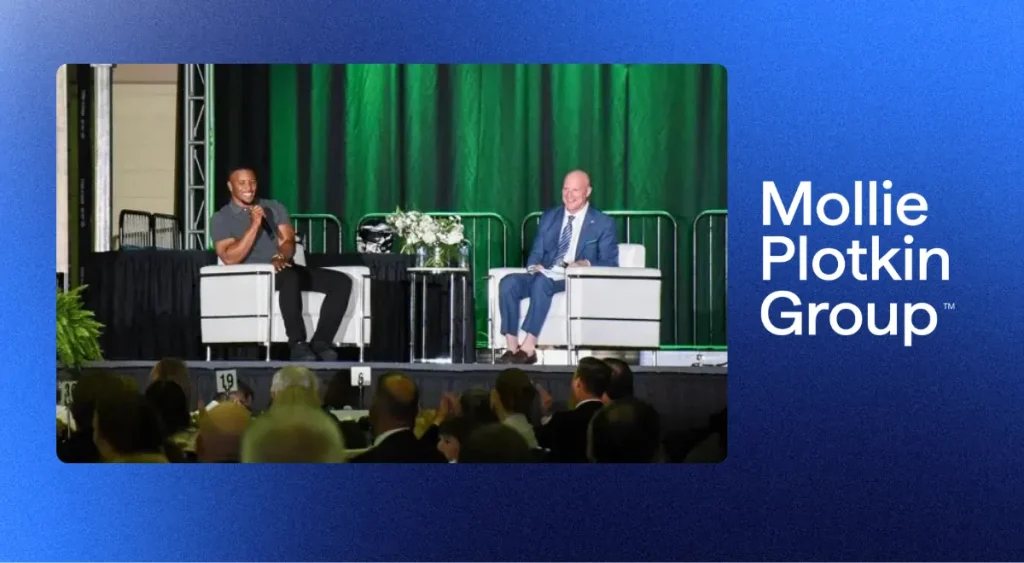
The Mollie Plotkin Group facilitates guest speaker conversations for Fortune 500 companies featuring heavy hitting speakers such as Seth Godin & Alex Banayan, and we welcome you to read our public case study on Saquon Barkley, and Dave Spadaro’s Q&A session.
These conversations had to support the events’ larger purposes while still giving the audience a memorable speaker experience.
Start by Asking the Speaker for Approved Questions
Before writing the full Q&A, ask the guest speaker or their team if they have preferred questions, approved topics, or sample prompts.
Many speakers already know which questions help them give their best answers.
They may also know which questions should be avoided.
For instance, an author may have preferred questions connected to their latest book, while a celebrity may have a controversy they’d like to avoid.
How to Write a Strong Q&A Question
A strong Q&A question should include a lead-in.
The lead-in gives context before the actual question. It helps the audience understand why the question is being asked. It also gives the speaker a clear direction for the answer.
A strong question might sound like this:
In your career, you helped build a company from $5 million to $1 billion in only four years. What was one upside and one downside of growing that quickly?
That question works because it gives the speaker a specific moment to respond to. It also points the answer toward something useful for the audience.
A stronger follow-up might sound like this:
Once the supply chain issues of the early 2020s hit, how did your team adjust to the pressure of rapid growth?
Here, we connect the speaker’s story to a broader business challenge.
A third question might sound like this:
How can other business owners prepare for a disruption before it becomes a crisis?
Now, we turn the speaker’s experience into a practical takeaway.
Broad questions are weak:
- What is the most memorable moment from your career?
- What was the most difficult business challenge you had to face?
- What advice would you give to new business owners?
They force the speaker to choose the context themselves. They also make it more likely that the answer will sound vague, rehearsed, or disconnected from the event theme.
A better question gives the speaker a starting point.
How Many Questions Should You Prepare?
Based on our experience preparing corporate speaker programs, ask 1 to 2 prepared questions for every 15 minutes of Q&A time.
That may sound low, but strong questions produce longer and more useful answers. If the question has a clear lead-in, the speaker can answer with a story, explain the lesson, and connect it back to the audience.
For a 15-minute Q&A, prepare 3 to 5 questions. You may only ask 1 or 2 of them. The extra questions give the moderator flexibility if the speaker answers quickly or if one topic does not land.
For a 30-minute Q&A, prepare 6 to 8 questions. You may only ask 4 or 5 of them. The moderator should leave room for follow-up questions and audience questions if the format allows them.
For a 45-minute Q&A or fireside chat, prepare 8 to 12 questions. The conversation should still feel natural, but the moderator should have enough material to keep the session moving.
Downloadable Guest Speaker Q&A Template
Use our downloadable guest speaker Q&A template to prepare questions before your corporate event, fireside chat, moderated discussion, or panel segment.
Page 1 is a planning worksheet that helps you define the speaker, audience, event goal, topics to cover, topics to avoid, and the structure of each question.
Page 2 is the actual moderator template, written in a simple format that you can modify, print, and give to your host so they can easily visualize the flow of the conversation.
Download the Guest Speaker Q&A Template
Guest Speaker Q&A Template
Use this structure when writing questions for a guest speaker. The first section helps you clarify the event’s focus. The second section turns your prepared questions into a clean moderator-facing format.
Page 1: Planning Worksheet
Write down the speaker and event name:
[Speaker Name]
[Event Name]
Who is your audience? Who will be in the room?
[Audience description]
What should the audience learn, feel, or discuss after the session?
[Event goal]
What topics or themes should be covered?
- [Topic 1]
- [Topic 2]
- [Topic 3]
- [Topic 4]
What topics or themes should be avoided?
- [Topic to avoid 1]
- [Topic to avoid 2]
- [Topic to avoid 3]
Question Format:
- Context: [Specific fact, moment, achievement, challenge, or quote]
- Question: [What should the speaker explain, reflect on, or teach?]
- Audience Connection: [Why does this matter to the people in the room?]
Prepared Questions:
- [Question 1]
- [Question 2]
- [Question 3]
- [Question 4]
- [Question 5]
Possible Follow-Up Questions:
- Can you tell us more about that moment?
- What changed after that experience?
- What did you learn from that decision?
- How would you approach that differently today?
- What should this audience take away from that story?
Page 2: Moderator Question Template
QUESTION 1
THIS TEXT IS QUESTION #1
FOLLOW UP
QUESTION 2
THIS TEXT IS QUESTION #2
FOLLOW UP
QUESTION 3
THIS TEXT IS QUESTION #3
FOLLOW UP
QUESTION 4
THIS TEXT IS QUESTION #4
FOLLOW UP
QUESTION 5
THIS TEXT IS QUESTION #5
FOLLOW UP
Sample Questions for Athletes
Athlete Q&A questions should focus on career-defining moments, team dynamics, pressure, preparation, recovery, leadership, and transition.
A fireside chat-style opening question can begin with the athlete’s background:
You grew up in [hometown or region]. What was that environment like, and what first drew you to [sport]?
From there, the questions should move into specific wins, teammates, challenges, and career shifts.
- In [year], your team won [championship, title, or major event]. What made the camaraderie of that team work?
- During your time with [team name], you played alongside [teammate name]. What did that experience teach you about leadership or preparation?
- In [year], you faced [injury, setback, trade, retirement, or career challenge]. What did it take to move through that period?
- When you returned to [the field, court, broadcast booth, team, or public stage], how did that moment feel?
- After your playing career, you moved into [broadcasting, business, coaching, advocacy, or speaking]. What was the hardest part of that transition?
- What does a corporate team misunderstand about the way elite athletes prepare?
- What lesson from your career applies most directly to leaders in this room?
The general rule is simple. Look for big wins, important teammates, major setbacks, and career transitions. Name them specifically in the question.
Sample Questions for Business Leaders and Entrepreneurs
Business leader questions should focus on decisions, growth, disruption, market timing, leadership, and lessons that apply to the audience.
- You launched [company name] in [year]. What did you understand about the market that others did not see yet?
- When you built [company name], there was no clear guidebook for that category. How did you make decisions when the path was still undefined?
- Your company grew from [specific starting point] to [specific milestone]. What changed about your leadership during that period?
- In [year or period], your industry faced [specific disruption]. What did that moment reveal about the way your organization operated?
- What recent trend in [industry] has surprised you most?
- Given the current state of [industry], what should leaders be preparing for now?
- You became the first [person/group/title] to [achievement] in [year]. How did that accomplishment feel personally?
- What do you think that milestone meant to others watching your career?
- Many entrepreneurs with your background face specific barriers when starting or scaling a business. How did those barriers affect you?
- How are you using your platform now to create change for others in the field?
The best business questions should avoid sounding like a résumé recap. They should use the résumé detail as the setup for a better answer.
Sample Questions for Subject Matter Experts
Subject matter expert questions should help the audience understand what is changing, why it matters, and what to do next.
- In your work on [topic], what shift are you seeing that most leaders have not fully understood yet?
- You have studied [specific issue] for years. What is the biggest misconception people still have about it?
- Given the current state of [industry, technology, economy, policy, culture, or market], what should organizations pay attention to first?
- What is one risk that leaders are underestimating right now?
- What is one opportunity that leaders are overlooking right now?
- When companies try to solve [problem], where do they usually start in the wrong place?
- What does the latest research suggest about [topic]?
- What should this audience stop doing if they want to make progress on [issue]?
- What should this audience start doing if they want to prepare for [change]?
- How should leaders think about [topic] differently over the next 3 to 5 years?
Subject matter expert questions should not only ask the speaker to explain the topic. They should ask the speaker to interpret the topic for the people in the room.
Sample Questions for Authors
Author Q&A questions should connect the book’s ideas to the audience’s goals.
Start by reading the speaker’s book, book summary, interviews, or press materials. Pull out a specific quote, chapter, theme, story, or framework. Then ask the author to expand on that idea.
- In your book, you write about [specific idea]. What made that idea important enough to build a chapter around?
- You describe [specific story or example] as a turning point. What did that moment teach you?
- One of the central ideas in your book is [theme]. How should this audience apply that idea in their work?
- You argue that [specific claim from the book]. What do people usually misunderstand about that point?
- Your book uses the phrase [specific phrase or framework]. Can you explain what that means in practical terms?
- You interviewed or researched [person, group, company, or case study] for the book. What surprised you most during that process?
- Since the book was published, has your thinking changed on [topic]?
- What part of the book do you think is most relevant to this audience?
- If someone in this room only remembers one idea from your book, what should it be?
Author questions should not be generic. “Tell us about your book” is too broad. A stronger question points to a specific idea inside the book and asks the author to make it useful for the audience.
Should You Take Audience Questions?
Audience questions can work well, but they need structure.
If the room has more than 20 people, the audience needs a microphone. The person asking the question should either wait for a runner with a microphone or walk to a fixed microphone. If there is no microphone, the moderator should repeat the question clearly before the speaker answers.
The event team should also decide whether audience questions will be live, submitted in advance, or screened during the event. Live questions can create energy, but they can also become long, unclear, or off-topic. Submitted questions give the moderator more control and can help avoid awkward moments.
Audience questions should have guidelines. The moderator can say something like:
We will take a few audience questions now. Please keep your question brief, and please make sure it is a question rather than a comment.
This reminder matters. Audience members sometimes use Q&A time to make statements, promote their own work, or ask questions that only apply to their personal situation. Clear instructions help keep the session useful for everyone.
The moderator should also keep an eye on the clock. If the Q&A has a hard stop, the moderator should say when there is time for one final question. This gives the audience a clear signal and helps the event stay on schedule.
Guest Speaker Q&A FAQ
How do you write good guest speaker questions?
Good guest speaker questions include context, a specific lead-in, and a clear direction for the answer. The question should reference a real moment, achievement, challenge, quote, book idea, or career shift from the speaker’s background. The strongest questions help the speaker give an answer that is useful to the audience.
How many questions do you need for a corporate Q&A?
A good rule of thumb is 1 to 2 questions for every 15 minutes of Q&A time. A 30-minute Q&A may only need 4 or 5 strong questions, but the moderator should prepare extra questions in case the speaker answers quickly. Strong questions usually produce longer answers because they include better context.
Should you send Q&A questions to the speaker in advance?
You should usually send Q&A questions to the speaker in advance. This helps the speaker prepare stronger answers and flag any topics that should be avoided. It also gives the moderator and speaker a shared understanding of the session’s direction.
What should you avoid asking a guest speaker?
You should avoid questions that are too vague, too personal, too sensitive, or unrelated to the event goal. You should also avoid questions about legal issues, medical details, politics, controversy, former employers, or family matters unless the speaker has clearly approved those topics. The safest approach is to confirm preferred and off-limit topics before the event.
Can audience members ask questions during a corporate Q&A?
Audience members can ask questions during a corporate Q&A if the format allows it. The event team should provide a microphone, set time limits, and tell attendees to ask concise questions. For larger or more sensitive events, submitted questions may work better than open-mic questions.
What is the difference between a Q&A and a fireside chat?
A Q&A usually follows a presentation and gives the audience or moderator a chance to ask questions about the speaker’s message. A fireside chat is usually a longer moderated conversation with prepared questions. A Q&A is often a supplement to a session, while a fireside chat is usually the session format itself.