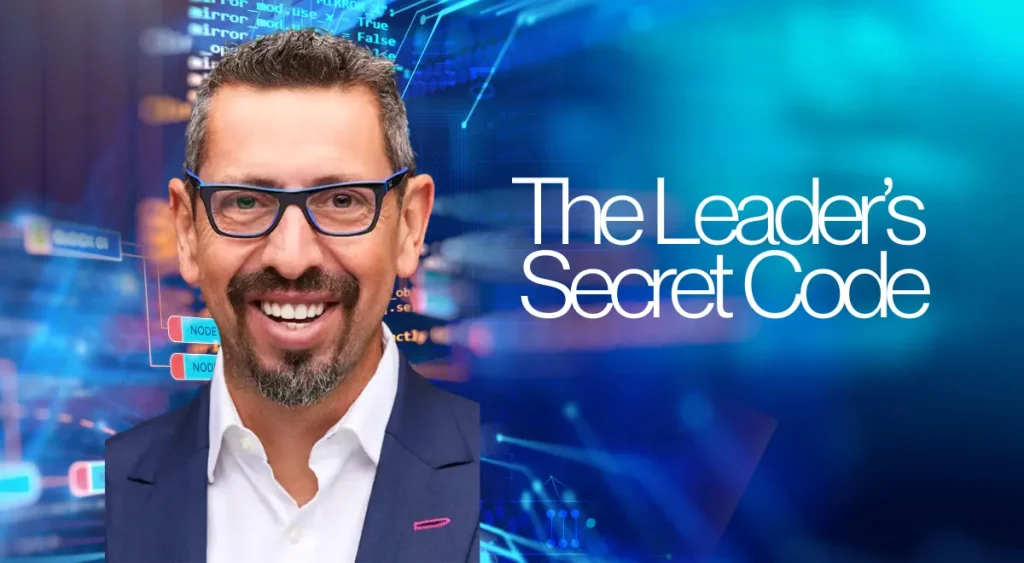
The Leader’s Secret Code: 7 Beliefs That Separate Great Leaders
Discover the 7 leadership beliefs that shape behavior, build resilience, strengthen influence, and help top leaders outperform under pressure.
AI Summary
A concise overview of The Leader’s Secret Code: 7 Beliefs That Separate Great Leaders, highlighting the main ideas, useful context and takeaways for event planners and professional audiences.
Guest post by Adam Pacifico
I have lost count of the number of times I have sat with a senior leader on a flight, after a keynote, or ten minutes before a board meeting and heard some version of this:
“I’ve got the skills, but something still isn’t clicking.”
That tension sits at the heart of The Leader’s Secret Code. The research behind it points to a simple but powerful truth:
Leadership performance is not driven only by what you do. It is shaped by what you believe.
Beliefs influence behavior. Behavior shapes outcomes.
So if you want to improve your leadership, do not start with tactics alone. Start with the belief system underneath them.
This framework is designed to be practical. It focuses on 7 core leadership beliefs, what they look like in action, and how strong leaders balance opposite styles rather than defaulting to one extreme.
The core idea behind The Leader’s Secret Code
Top-performing leaders do not succeed because they happen to hold “better” beliefs by accident.
They develop beliefs that help them:
- create useful, repeatable behaviors
- stay adaptable under pressure
- build trust and followership
- balance competing leadership demands
That final point matters most.
Great leadership is rarely about living at one end of a spectrum. More often, it is about knowing when to shift style, tone, and approach without losing clarity or conviction.
The 7 leadership beliefs that separate stronger leaders
1. Control: “Someone or something must be accountable.”
Strong leaders believe accountability matters, but they do not all express it in the same way.
Two common leadership modes sit underneath this belief:
- Directive leadership: setting direction clearly and leading from the front
- Participative leadership: involving others in shaping the way forward
The challenge is not choosing one forever. It is knowing which one the moment requires.
How to apply it:
In your next meeting, ask yourself:
What decision am I still holding that someone else is closer to?
Then delegate it with two things:
- a clear definition of success
- a check-in point for review
That is how accountability grows without losing control.
2. Resilience: “I can take pressure and bounce back.”
Resilience is often misunderstood as pure endurance. In reality, the best leaders know that resilience includes both persistence and adaptation.
This belief tends to show up through two modes:
- Work hard: raising effort to push through difficulty
- Work smart: redesigning the approach when the old one is no longer working
The strongest leaders do both. They know when to stay the course and when to rethink the route.
How to apply it:
Run a 10-minute reset review this week and ask:
- What is the real problem?
- What have we already tried that will not work again?
- What is one fresh experiment we can run in the next 7 days?
Resilience is not about pushing harder forever. It is about knowing when effort is useful and when redesign is smarter.
3. Influence: “Leadership is making things happen through others.”
Leadership is not just personal capability. It is the ability to move people, align effort, and create momentum through others.
This belief often shows up in two forms:
- Transactional influence: using structure, authority, process, and expectations
- Transformational influence: using energy, meaning, encouragement, and inspiration
Both matter. Systems create clarity. Inspiration creates commitment.
How to apply it:
Before asking for execution, give people meaning.
Use this sequence:
- Here is what winning looks like
- Here is why it matters
- Here is what I need from you
If your influence depends mostly on title or hierarchy, it will weaken under pressure. Real influence runs deeper than formal authority.
4. Communication: “A good leader communicates to people and audiences.”
High-performing leaders understand that communication is not just about transferring information. It is about creating clarity, trust, and movement.
This belief usually balances two modes:
- Unemotional communication: facts, logic, precision, clarity
- Emotional communication: authenticity, story, empathy, vulnerability
Strong leaders can use both without sounding forced.
How to apply it:
Use a two-layer message in your next important communication:
The facts:
What is changing? What is true? What matters now?
The human layer:
What does this mean? What do I feel? What do I need from people?
The best communicators know how to flex tone without compromising truth.
5. Strategy: “We know where we’re going and how we’ll win.”
Leadership without direction quickly becomes drift. Strong leaders hold a belief that strategy must provide both clarity and movement.
That usually involves balancing two modes:
- Fact-based strategy: data, evidence, research, and predictability
- Intuitive strategy: judgement, pattern recognition, experience, and risk sense
Strategy works best when both are in conversation.
How to apply it:
Use this filter on an important decision:
- What does the data suggest?
- What does experience suggest?
- If we are wrong, what is the cheapest way to find out quickly?
Strategy is not just a document or planning session. It is a living direction paired with adaptive execution.
6. Empowerment: “My people feel able to act and do their best work.”
Empowerment is not the absence of structure. It is the combination of freedom and clarity.
This belief often plays out through two styles:
- Ambiguous empowerment: freedom, trust, and ownership
- Unambiguous empowerment: clear boundaries, expectations, and limits
Too much freedom can create confusion. Too much control can shut people down.
How to apply it:
Give people a clear decision box:
- Decisions you own
- Decisions we share
- Decisions I own
That simple structure creates more confidence, better decision-making, and less duplication.
7. Fulfilment: “I am most fulfilled when I am successful.”
Fulfillment is often treated as a personal issue, but it also affects performance, energy, and long-term leadership quality.
This belief often shows up in two forms:
- Achievement-driven fulfillment: results, progress, recognition, accomplishment
- Affiliation-driven fulfillment: connection, contribution, shared success, legacy
Both can be healthy. Problems start when success is defined too narrowly.
How to apply it:
Ask yourself one question that is hard to fake:
What do I want to be known for through other people’s lives?
Fulfillment matters because it influences how leaders sustain effort. If success only means personal achievement, leaders can burn bright and still burn out.
The takeaway
Better leadership does not begin with a new toolkit.
It begins with a better internal operating system.
That is the deeper message behind The Leader’s Secret Code: the beliefs leaders hold quietly shape the behaviors everyone else sees publicly.
If you want to test this framework, start small.
Pick one of the seven beliefs and pressure-test it for the next seven days:
- Where am I overusing one style?
- Where do I need more balance?
- What one behavior will I change immediately?
Small belief shifts lead to behavior shifts.
Behavior shifts create visible leadership outcomes.
About the Author

Adam Pacifico is the host of the globally ranked, award winning podcast The Leadership Enigma, author and Partner at Heidrick & Struggles.
Decoded: The Leadership Enigma weekly newsletter
Over 400 videos – The Leadership Enigma YouTube channel


